
High Ligation
The pediatric high ligation operation, further refined by Drs. Takahara, Patkowski, and Ponsky, has made its way to be a viable option for adults wishing to avoid mesh.
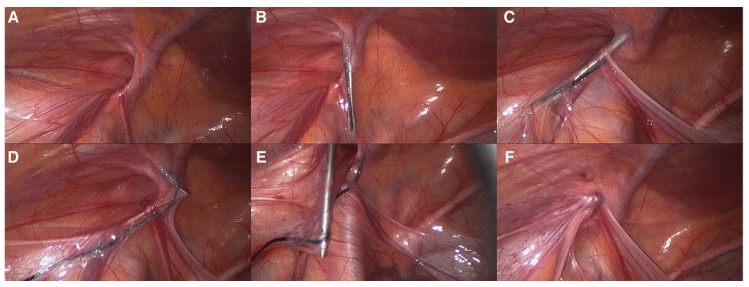
Closing the internal ring with a percutaneous suture (link to paper)
High Ligation
The internal ring is a unique anatomical structure. It involves a complex arrangement of multiple muscle layers of the abdominal wall oriented in an oblique fashion. In children, it has long been known that a high ligation of the hernia sac at the internal ring is most often all that is needed to repair pediatric hernias. Recurrence rates are about 1-5%, comparable to modern adult recurrence rates. Adult operations though in general are more elaborate and often involve the use of mesh.
Some pioneering pediatric and adult hernia surgeons have asked the question when can this technique be utilized in adults with similar results. This is currently under investigation but preliminary results are very positive and encouraging.
Protocol
With proper evaluation and patient education, we offer certain procedures still under further study. Here we provide information on our procedure protocol. These procedures have been performed and do have encouraging results, but research and experience with them has not been as robust as the standard procedures. As a reminder, the standard no-mesh procedures with robust evidence and experience are: Shouldice, Desarda, and McVay. But for selected patients, it appears high ligation will have similar results with lower risk of complications.
Inclusion Criteria:
-
Patients must understand the limited research, data, and experience with some of the newer techniques.
-
Patients have been fully educated on the pros and cons of mesh usage and wish to proceed with an experimental no-mesh technique.
-
Patients must be committed to an abdominal and inguinal canal rehab program (this typically requires 10-15 minutes of exercises and stretching per day coupled with a healthy diet and lifestyle).
Exclusion Criteria:
-
Patients must be at a normal or near-normal weight (e.g. BMI <30-35).
-
Patients must be otherwise healthy (e.g. no cirrhosis or major medical condition).
-
Direct hernias identified pre-operatively or at time of operation.
Preop Protocol:
-
Patients are optimized for surgery (as with all our procedures).
-
Patients have an ultrasound in our Jupiter clinic to ascertain if they have a direct hernia and/or a cord lipoma.
Procedures:
-
First-look laparoscopy: This requires general endotracheal anesthesia. Dr. Cober starts by assessing the inguinal canal with an intra-abdominal view — this definitively rules out direct hernias which are a contraindication to our experimental procedures. The surgical robot then may be used to proceed with the operation depending on the anatomy seen.
-
High ligation: This is perhaps the least invasive procedure available with perhaps the most safety and lowest pain, all with comparable recurrence rates of 1-3%. This is contraindicated with cord lipomas. Recommended with a permanent suture although can be done with an absorbable suture.
-
TEP with absorbable mesh: This is more of a standard hernia operation with the use of an absorbable mesh. It likely has few benefits over the high ligation with the downside of increased risk of hematoma and pain and operative time. This procedure however can deal with cord lipomas.
-
Open procedure: This can be done with general anesthesia with an LMA or MAC anesthesia.
-
High ligation: Here a small incision is made directly over the internal ring, the hernia sac is ligated and any cord lipomas are resected. The internal ring may be tightened with Marcy, Kang, or Lytle sutures. At this time we do not offer absorbable mesh reinforcement as it is unknown if this could cause too much scarring resulting in nerve pain. This procedure is an option for patients with a contraindication to general anesthesia.
-
Lichtenstein with absorbable mesh: This is a standard anterior repair with an absorbable mesh patching the inguinal canal which has had all its defects closed. At this time we do not offer this procedure as it is felt to not offer benefit over our standard non-mesh techniques, but this could be a topic for future study.
-
If you are interested in any of these procedures, you may discuss this with us at time of consultation and we can help you determine if one of them would be safe and appropriate in your situation.
References:
_____
https://www.coberhernia.com/about/hernia-education/high-ligation